
EBATINCA contributes to a major advancement in cardiac procedures
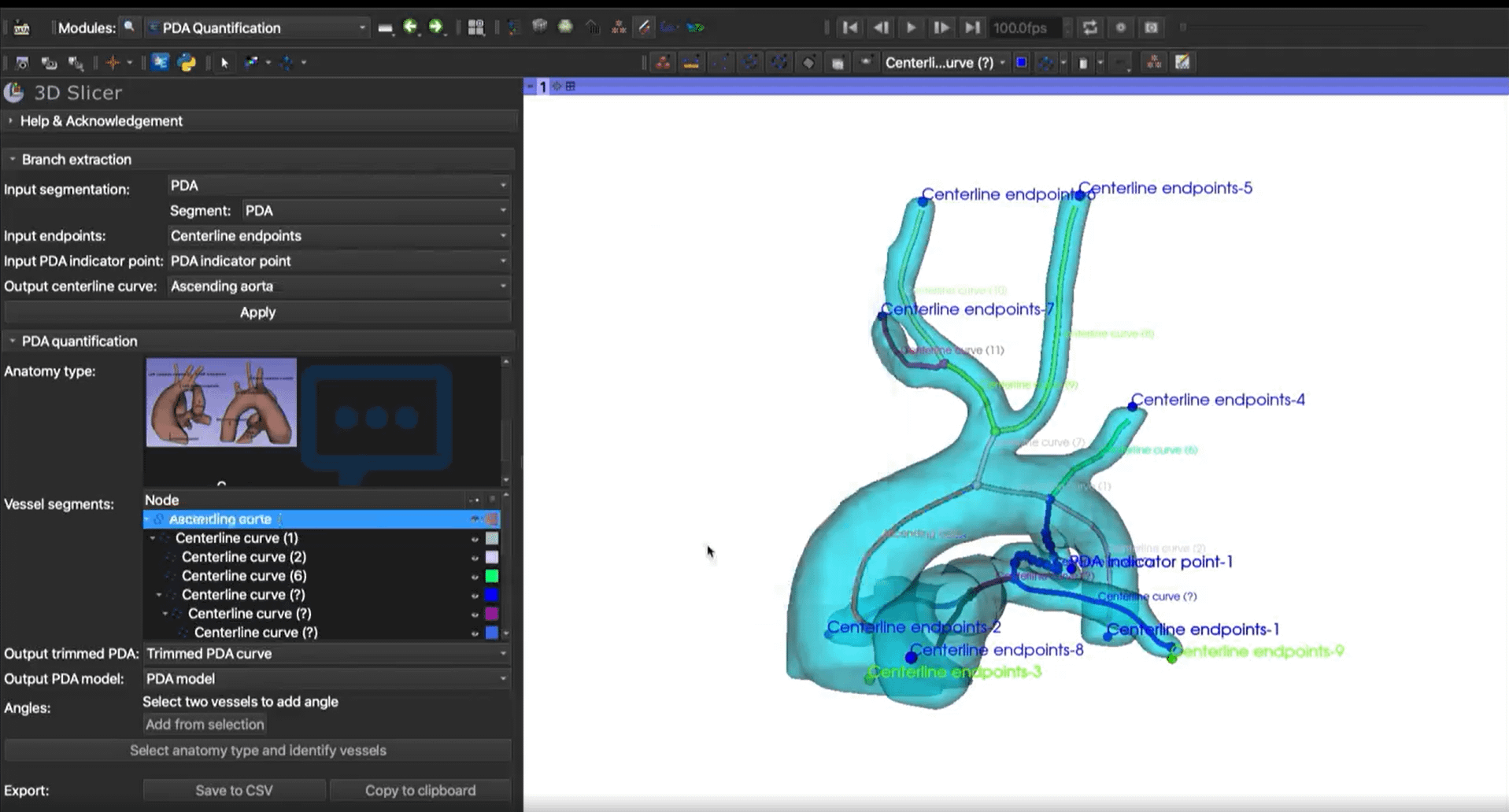
Years of collaboration have brought fruit. EBATINCA has developed innovative tools that have resulted in a significant scientific publication in collaboration with Dr. Matthew Jolley’s team at the Children’s Hospital of Philadelphia. This work focuses on the quantitative analysis of three-dimensional anatomy to aid in planning ductal arteriosus stenting.
The study (https://pubmed.ncbi.nlm.nih.gov/40152008/), titled “Quantitative Analysis of 3D Anatomy to Inform Planning of Ductal Arteriosus Stenting”, highlights the development of open-source software to model and quantify ductal arteriosus anatomy in neonates with ductal-dependent pulmonary blood flow.
To carry out this project, a custom extension was developed for widely used and flexible geospatial tools like QGIS. This allows companies in the sector to easily access advanced functionalities for geospatial image analysis. The prediction is generated by a ResNet model, an advanced convolutional neural network (CNN) architecture. ResNet (Residual Networks) are known for learning more complex representations and improving performance in image classification tasks.
The newly developed module enables processing both a set of images and an individual image selected by the user. This allows for analysis of all images in a project, automatically filtering those with a suitable raster format for processing. Alternatively, users can select a specific image from the file explorer to obtain individual predictions. Once results are generated, they can be viewed in the results tab, where predictions can be reviewed and previewed in JSON format, facilitating export to standard formats such as JSON and CSV.